Heavy duty towing is not a heavier version of standard towing. It is a different discipline — different equipment, different operator training, different coordination requirements, and a different cost structure entirely. In Austin, where I-35 runs one of the most active commercial freight corridors in Texas through the center of a rapidly growing metro, the demand for capable heavy duty operators is constant and the consequences of sending the wrong equipment are severe.
This guide covers what heavy duty towing actually involves in Austin, what situations require it, what the I-35 and US-290 commercial corridors mean for operators working this market, and what to look for when you need a company that can actually handle the job.
What Heavy Duty Towing Actually Is
Heavy duty towing covers vehicles and equipment above the weight and size limitations of standard light or medium-duty wreckers. The practical threshold begins around 26,000 lbs gross vehicle weight, though the specific equipment required varies significantly based on vehicle configuration, breakdown type, and recovery complexity.
The core equipment distinction is critical. Heavy duty recovery uses purpose-built rotating bed recovery vehicles — often called rotators — or heavy underlift rotators with lift capacities rated for commercial vehicle weights. These are not the same trucks that handle passenger car tows. A rotator can weigh 60,000 lbs or more, has a 360-degree rotating boom, and is designed specifically to upright, recover, and transport vehicles that light and medium-duty equipment cannot safely touch.
Operators who work heavy duty recovery hold specialized training and certification beyond the standard TDLR tow truck license. They understand commercial vehicle rigging points — which vary significantly across semi configurations, flatbeds, dump trucks, and tankers — as well as load stabilization, weight distribution, and the coordination requirements for highway recovery scenes involving law enforcement and TxDOT.
A light-duty wrecker crew attempting a heavy duty recovery is not just inadequate. It is a safety risk to the operators, to other drivers on the road, and to the vehicle being recovered. It can also cause additional structural damage to a commercial vehicle that was already disabled.
What Vehicles Require Heavy Duty Towing in Austin
Semi-trucks and tractor-trailers are the most common heavy duty tow call in Austin. I-35 through the city, US-290 east and west, and US-183 carry substantial commercial freight volume daily. Disabled, accident-involved, or overturned semi-trucks on any of these corridors require heavy rotator equipment and operators with commercial recovery experience. These scenes are also typically managed by APD, TxDOT, or Travis County, which adds a coordination layer that heavy duty operators navigate as a routine part of the work.
Dump trucks, tanker trucks, and commercial box trucks involve weight distributions and structural configurations that go well beyond what light-duty equipment handles. A loaded dump truck can easily exceed 60,000 lbs. A tanker adds complexity around load type — fuel, chemicals, or other materials that affect recovery procedures and may require coordination with hazmat teams.
Cement mixers and concrete pumpers are common on Austin’s active construction corridors. These vehicles combine significant weight with a rotating drum configuration that affects how rigging is applied during recovery.
Construction equipment — excavators, bulldozers, motor graders, skid steers — may need emergency transport from a job site or recovery after mechanical failure or a slide on a grade. The combination of weight, track or wheel configurations, and non-standard rigging points makes this a specialized call.
Large RVs and motorhomes, particularly Class A coaches, frequently exceed the capacity of light-duty equipment. A full-size Class A diesel pusher can run 40,000 lbs or more fully loaded, and the length creates additional rigging and transport complexity.
Buses — charter, transit, and school buses — require medium-to-heavy duty equipment depending on configuration, and are common on Austin’s event-heavy calendar of Formula 1, SXSW, ACL, and UT football weekends.

Austin’s Commercial Corridors and Why They Drive Heavy Duty Demand
Austin sits at the intersection of some of the most active freight routes in Texas, and the growth of the metro over the past decade has significantly increased commercial vehicle volume on roads that were not designed for it.
I-35 through Austin is the primary north-south commercial freight corridor in Central Texas. It runs through downtown, past the airport, through the Domain and North Austin tech corridor, and connects San Antonio to the south with the Dallas-Fort Worth metro to the north. Commercial truck breakdowns on I-35 create immediate lane closure issues, traffic backup, and in many cases require coordinated response with TxDOT’s incident management program and APD. The towing operator needs to be on-site quickly, with the right equipment, and capable of coordinating with law enforcement from the moment they arrive.
US-290 carries freight both east toward Houston and west into the Texas Hill Country, where road grades and curves create additional difficulty for disabled commercial vehicles. A semi that breaks down on a grade west of Austin on US-290 is a categorically different recovery than one that stops on a flat urban segment.
US-183 and SH-130 serve the eastern logistics and distribution corridor of the Austin metro. The growth of warehousing and logistics operations east of the city has increased heavy vehicle volume substantially. SH-130 in particular, as a bypass toll corridor, carries heavy trucks that use it to avoid I-35 congestion — and its higher speed limits mean breakdowns happen at higher closing speeds.
For any commercial vehicle breakdown on these corridors, a proper towing company in Austin that handles heavy duty recovery needs distributed fleet positioning, not a single yard on one side of the metro. Response time on an active commercial highway corridor matters — every additional minute a disabled semi sits in a travel lane or on a narrow shoulder is an elevated risk to other drivers.
Heavy Duty Recovery Scenarios: What They Actually Involve
Roadside breakdown — non-accident. A commercial vehicle has a mechanical failure and stops in a safe location — on a shoulder, a pull-out, or off the active roadway. This is the cleanest heavy duty scenario. The operator arrives, rigs the vehicle correctly for its configuration, and transports it to a repair facility or truck stop. The coordination burden is lower but the equipment and rigging requirements are the same.
Accident recovery on a highway. A commercial vehicle has been involved in a collision and is partially or fully blocking a travel lane. This is the most time-sensitive heavy duty scenario and involves the most coordination. Law enforcement manages the scene. TxDOT may be coordinating traffic management upstream. The towing operator needs to assess the vehicle’s condition, determine the correct rigging approach, and execute the recovery without additional damage to the vehicle or risk to the crew working in an active corridor. If cargo has spilled, hazmat and cleanup crews may be involved before the vehicle can be moved.
Rollover recovery. A commercial vehicle that has rolled on a highway or off-road requires a rotator to right the vehicle before it can be transported. This is the most complex and physically demanding heavy duty recovery type. The operator must assess load condition, structural integrity, and rigging points specific to that vehicle configuration before any lift begins. An incorrect lift on a rolled semi can cause further structural damage or create a secondary hazard.
Off-road or grade recovery. A commercial vehicle that has left the road surface — down an embankment on US-290 west, off a grade in the Hill Country, into a ditch on a rural approach road — requires heavy winch capacity and often a ground anchor setup before the rotator can engage. The terrain surrounding Austin, particularly west of the city, makes this a scenario that experienced Austin heavy duty operators encounter regularly.
What to Confirm Before You Call a Heavy Duty Towing Company in Austin
Not every company that uses the phrase “heavy duty towing” in their marketing actually has the equipment and operator certifications to handle commercial vehicle recovery. Before you dispatch:
Ask for the specific equipment they’re sending. What is the rotator model and lift capacity? Is it rated for the weight and configuration of your vehicle? A company confident in their capability answers this without hesitation.
Ask about operator certification. Heavy duty recovery operators should hold credentials specific to commercial vehicle recovery beyond the standard TDLR tow truck operator license. Wreckmaster, TRAA, or similar professional certification programs exist specifically for this category of work.
Ask whether they have experience on Austin’s commercial corridors. I-35 recovery experience, TxDOT coordination familiarity, and APD rotation list standing are all relevant for highway commercial recovery in Austin. An operator who works these corridors regularly has a different level of preparation than one doing their first highway semi-recovery.
Ask about availability. Heavy rotators are expensive assets. Some companies have one and some calls have it already deployed. Confirm the equipment is available for your call right now, not just that the company owns one.
For established heavy duty towing in Austin with verified equipment capacity and operators who work the commercial corridors regularly, the company’s history in the market is one of the most reliable signals you have.
Flatbed Towing in Austin: Where It Fits Within Heavy Duty Service
Flatbed towing — where a vehicle is transported on a platform with all wheels off the ground — is frequently part of heavy duty operations but is not synonymous with heavy duty towing. The distinction matters:
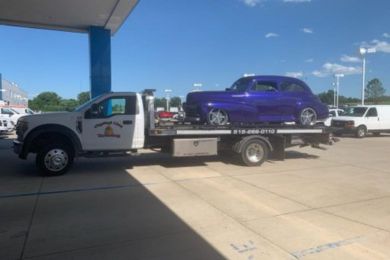
A standard light-duty flatbed rollback handles passenger vehicles, motorcycles, low-clearance cars, and AWD vehicles that need all four wheels off the ground during transport. This is common, widely available, and appropriate for most passenger vehicle towing situations.
A heavy duty flatbed — sometimes called a heavy duty transport or lowboy for equipment — carries commercial vehicles, construction equipment, or multiple vehicles simultaneously. These platforms have significantly higher load ratings and require the same operator expertise as any other heavy duty recovery.
When a commercial vehicle needs to be transported after recovery — after a rollover is righted, after a disabled semi is stabilized — a heavy duty flatbed or transport bed is often part of the solution. But the flatbed itself is only one piece of a heavy duty operation that may also involve a rotator, winch recovery, load transfer, and multi-truck coordination.
Frequently Asked Questions: Heavy Duty Towing in Austin
How much does heavy duty towing cost in Austin? Heavy duty towing for commercial vehicles is priced based on vehicle type, recovery complexity, equipment deployed, and time. Unlike light-duty consent tows where market pricing is fairly predictable, heavy duty recovery can vary substantially — a straightforward roadside semi pickup differs significantly in cost from a rolled tanker with spilled cargo. Request a quote that accounts for the specific vehicle and situation. For non-consent tows, TDLR sets maximum rates by vehicle weight class, but heavy duty rates are substantially higher than the light-duty cap.
How long does heavy duty towing take on I-35 in Austin? Arrival time depends on fleet positioning and traffic conditions on Austin’s congested highway network. Once on-site, the recovery itself depends on the scenario — a straightforward breakdown may clear in 30 to 45 minutes, while a rollover recovery on an active highway can take several hours given law enforcement coordination, rigging complexity, and potential cargo considerations. TxDOT’s clearance targets for Austin highway incidents emphasize speed, and experienced operators who work these corridors know those expectations.
Do I need special insurance for heavy duty towing in Austin? Most commercial carriers include roadside and towing coverage in their commercial vehicle insurance policies, though coverage limits and approved vendors vary. Confirm with your carrier what coverage applies before a breakdown happens. If you manage a fleet, knowing in advance which Austin heavy duty operators your insurer approves for direct billing eliminates one variable in an already stressful situation.
Can a heavy duty tow truck handle both the recovery and the transport to a shop? Sometimes, but not always. Complex recoveries — particularly rollovers or off-road extractions — may require one set of equipment for the recovery itself and a transport truck for moving the vehicle once it’s stabilized and back on the road surface. Heavy duty operators running full-service operations have both, or coordinate the two. Ask specifically whether the operator can handle transport after recovery or whether a second dispatch is needed.
What is a rotator in heavy duty towing? A rotator is a heavy recovery vehicle with a 360-degree rotating boom arm. Unlike a standard wrecker that can only pull in the direction the truck is facing, a rotator can position its boom at any angle — which is essential for righting rolled vehicles, extracting vehicles from positions where the recovery truck can’t be placed directly behind, and working in the tight confines of an Austin highway median or barrier-lined interchange.
The Standard for Heavy Duty Towing in Austin
Commercial vehicle recovery done correctly requires the right equipment, the right operator training, and direct experience on the specific corridors where the work happens. Austin’s commercial freight network — particularly I-35, US-290, and US-183 — creates a consistent demand for operators who meet that standard.
Quick Tow Austin has operated in Austin since 2011 with heavy duty capability, licensed operators, and a track record on Austin’s commercial corridors.